
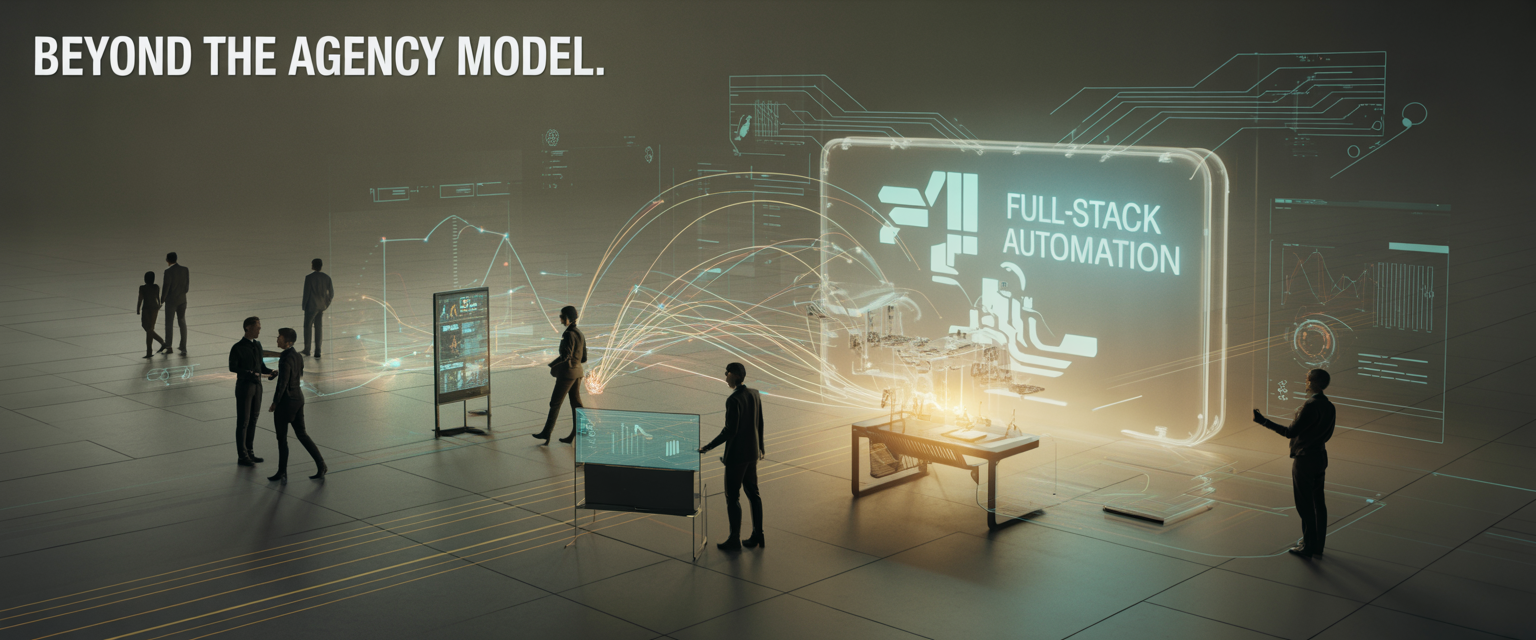
How Full-Stack Marketing Automation Transforms B2B Growth
Beyond the Agency Model: How Full-Stack Marketing Automation Transforms B2B Growth
The modern B2B marketing stack is broken. Not because the tools are bad—the tools are actually incredible. The problem is how they're stitched together.
Most companies work with multiple vendors to cover their marketing needs. One agency handles paid search. Another runs social campaigns. A third manages programmatic display. Someone else provides data enrichment. A consultant helps with CRM configuration. A freelancer builds automation workflows. And maybe, if you're lucky, someone tries to coordinate all of these moving parts.
Each vendor is optimizing for their piece of the puzzle. Your search agency wants to prove search ROI. Your social agency wants to prove social ROI. Your automation consultant wants to show workflow efficiency. But nobody is optimizing for the thing that actually matters: efficient revenue generation across the entire system.
This fragmentation doesn't just create coordination headaches. It fundamentally limits what's possible.
The Hidden Tax of Specialization
The agency model evolved around specialization for good reasons. Paid search requires different expertise than programmatic advertising. Meta campaigns operate on different principles than Google Ads. Marketing automation demands technical knowledge that most media buyers don't have.
So the market fragmented. Agencies specialized. Everyone got very good at their particular discipline. And B2B companies assembled teams of specialists to cover all the bases.
But specialization created new problems that are arguably worse than the ones it solved.
Data Silos Everywhere
Your search agency has performance data that your social agency never sees. Your programmatic vendor is optimizing without knowing what's happening in paid social. Your CRM data doesn't flow to your ad platforms in real-time. Your marketing automation triggers don't account for cross-channel behavior.
Each system has a piece of the customer journey, but nobody has the complete picture. You're flying blind while claiming to be data-driven.
Attribution Becomes Impossible
When multiple vendors are running multiple campaigns across multiple platforms, attribution falls apart. Your search agency takes credit for conversions that were influenced by display. Your social agency claims success for leads that came through after multiple touchpoints. Your actual customer journey looks nothing like what any single vendor is reporting.
The result? You make optimization decisions based on incomplete information. You might kill a programmatic campaign that's actually driving qualified traffic to your search campaigns. You might double down on channels that look good in isolation but aren't contributing to actual revenue.
Integration Overhead Kills Velocity
Want to launch a new campaign targeting a specific segment? Now you need to coordinate across four vendors. Brief the search team. Brief the social team. Get the programmatic campaigns set up. Make sure the CRM can capture the data properly. Update the automation workflows. Configure the tracking.
What should take a day takes two weeks. By the time everything is live, the market has moved. Your competitors have already captured the opportunity you identified.
Optimization Happens in Slow Motion
Each vendor runs their optimization cycle independently. Search campaigns get optimized weekly. Social ads get refreshed on a different schedule. Programmatic runs its own testing cadence. Nobody is making real-time adjustments based on what's working across the entire system.
You're not iterating quickly. You're managing a committee that occasionally implements changes after everyone has weighed in and agreed on next steps.
What Full-Stack Actually Means
Full-stack marketing automation isn't about one vendor doing everything. It's about unified intelligence driving coordinated action across every channel simultaneously.
It starts with a single source of truth—buyer intent data, CRM information, engagement signals, and conversion data flowing into one system. Not aggregated in a dashboard you check once a week. Actually unified in real-time, powering decisions across every channel.
From that foundation, everything changes.
Cross-Channel Intelligence
When someone engages with your content on one channel, that signal immediately informs targeting and messaging on every other channel. A prospect who clicked your LinkedIn ad but didn't convert gets retargeted with programmatic display addressing their specific use case. Someone who visited your pricing page triggers automated outreach from your sales team while also entering a nurture sequence and seeing refined messaging in their social feeds.
This isn't marketing automation in the traditional sense—triggered emails and lead scoring. This is your entire go-to-market operation learning and adapting based on every signal from every touchpoint.
Unified Testing and Learning
Instead of each channel optimizing independently, you test hypotheses across the entire system. You're not just testing ad creative in Facebook. You're testing whether a certain value proposition resonates better with in-market buyers across paid search, display, social, and email simultaneously.
Learnings compound instead of staying siloed. A messaging insight from your search campaigns immediately improves your social creative. An audience segment that converts well in programmatic gets prioritized in paid social. A CRM field that predicts close rates influences targeting across all channels.
Resource Allocation in Real-Time
Budget doesn't get locked into monthly retainers with individual agencies. Resources flow to wherever intent signals are strongest right now. If your data shows increased buying activity in a specific segment, budget automatically shifts to capture that demand across every relevant channel simultaneously.
You're not waiting for month-end reports to decide where to invest. The system is reallocating resources daily based on where actual opportunities exist.
The Crypto Trading Platform That Couldn't Scale
One of our clients came to us after spending two years trying to scale their acquisition engine. They were working with a respected search agency, a well-known social agency, and had built internal capabilities for email marketing and basic automation.
On paper, everything looked fine. Each channel was hitting its targets. Cost per click was acceptable. Conversion rates were in line with benchmarks. But when you looked at the actual business metrics—cost per qualified lead, customer acquisition cost, payback period—the numbers didn't work.
The problem wasn't that any individual channel was failing. The problem was that nobody was optimizing for the business outcome. The search agency was optimizing for search metrics. The social agency for social metrics. The internal team for email metrics.
Prospects were seeing disconnected messages across different touchpoints. Someone who engaged with educational content on social would get retargeted with competitor comparison ads in search. The automation sequences triggered based on form fills regardless of where someone was in their actual journey. The sales team received leads with incomplete context about how those leads had engaged across channels.
When we rebuilt their infrastructure as a full-stack operation, we didn't just consolidate vendors. We fundamentally restructured how the system worked.
Buyer intent data started flowing in real-time, identifying traders who were actively researching platforms. That intent data immediately informed targeting across Google, Meta, and programmatic—not days later after a sync, but instantly. When someone showed strong intent signals, the entire system responded. Ad frequency increased. Messaging shifted to address their specific use case. Sales outreach triggered. Automation sequences adapted to their demonstrated interests.
Their cost per qualified lead dropped by 43% in the first quarter. But the more important change was strategic. They could now test and learn at a pace that was previously impossible. They could identify emerging segments and capture them before competitors even noticed the opportunity. They could scale spend confidently because the entire system was learning what worked and doing more of it automatically.
The Infrastructure Nobody Sees
The most important parts of a full-stack marketing operation are invisible to prospects. They're not the ads or the landing pages or the email sequences. They're the data pipelines, the integration layer, and the intelligence engine that powers everything.
This infrastructure ensures that every touchpoint has context about every other touchpoint. That your CRM knows what ads someone clicked. That your ad platforms know who's engaging with your sales team. That your automation workflows understand where someone is in their actual buying journey, not just what form they filled out.
This is where traditional agencies fall short—not because they lack talent or commitment, but because they're not structured to build this kind of infrastructure. They're built to execute within their specialty, not to orchestrate complex systems.
Building this infrastructure requires a different approach. It requires understanding not just how to run effective campaigns, but how to architect data flows, integrate disparate systems, and create feedback loops that enable intelligent automation at scale.
It means being equally comfortable in Google Ads Manager and in your CRM's API documentation. It means understanding both creative strategy and data architecture. It means thinking about campaigns not as isolated initiatives but as components in a larger system.
From Coordination to Orchestration
The difference between coordinating multiple vendors and operating a full-stack system is the difference between a group of musicians playing their parts and an orchestra performing a symphony.
In the first scenario, everyone is technically doing their job correctly, but the result is cacophony. There's no unified vision, no coordination, no building toward a climax. Just individual performers executing their parts.
In the second scenario, every instrument plays in service of the whole. The tempo is synchronized. The dynamics support each other. Individual brilliance serves the composition rather than competing with it.
B2B companies that crack this code don't just improve their marketing efficiency. They build an entirely different kind of growth engine. One that learns faster, adapts quicker, and scales more efficiently than anything the traditional agency model can deliver.
The specialized agency model made sense in a simpler time. But as B2B buying journeys become more complex, as channels proliferate, as real-time data becomes table stakes, that model is increasingly a limitation rather than an advantage.
The question for B2B leaders isn't whether you need expertise in different channels—you absolutely do. The question is whether that expertise should live in separate organizations optimizing for separate goals, or within an integrated system optimizing for revenue.